AMC’s $18 Token: Who Controls the Supply?
When Robinhood’s AMC Stock Token soared far above the underlying shares, token supply reportedly expanded nearly tenfold. The price came back down. NakedShortStop™ follows what happened – and asks what happened to the shares supposedly backing the new tokens.
NakedShortStop™ Market Structure | September 6, 2026
Something unusual happened in the market for Robinhood’s AMC Stock Token.
AMC Entertainment shares had closed at approximately $2.54.
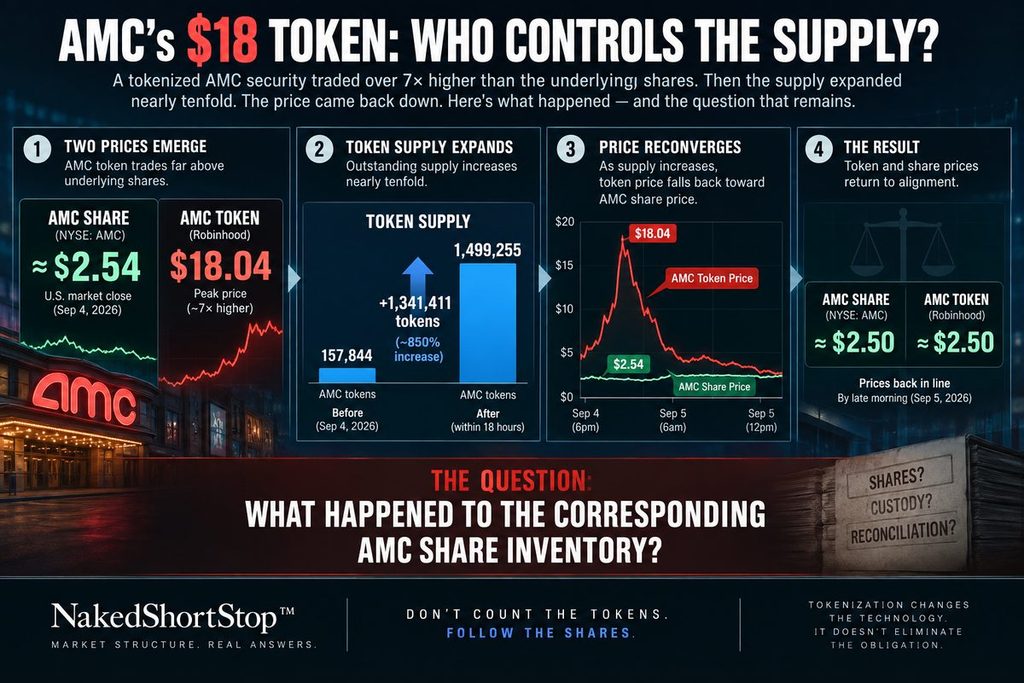
Hours later, while the U.S. equity market was closed, the AMC-linked token traded as high as $18.04 – more than seven times the price of the stock it was designed to track.
Then something else happened.
The reported supply of AMC Stock Tokens increased from approximately 157,844 tokens to 1.5 million tokens within 18 hours.
By late morning, the extraordinary premium had largely disappeared and the token was once again trading near the price of AMC shares.
That sequence raises a market-structure question extending far beyond AMC:
When the supply of a tokenized security can be expanded to restore price convergence, who controls that supply – and what happens to the real shares supposedly backing the new tokens?
Two Markets, Two Prices
Robinhood’s AMC Stock Token is not an AMC share.
It is a tokenized debt security issued by Robinhood Assets (Jersey) Limited, or RHJ. Robinhood states explicitly that Stock Tokens provide economic exposure to their underlying securities but give token holders no legal or beneficial ownership rights in the underlying company.
That distinction matters.
AMC trades in the conventional U.S. securities market.
Robinhood’s AMC token can trade independently through blockchain-based markets available to eligible non-U.S. investors.
Normally, arbitrage should keep the prices reasonably close.
But the AMC episode demonstrated what can happen when those markets separate.
With the underlying AMC shares around $2.54, the token reportedly reached $18.04.
This was not merely a few cents of tracking error.
It was an enormous price dislocation.
And historical data suggest that it may not have been the first. CoinGecko records the AMC token closing at $12.92 on August 30, surrounded by trading days when it was generally near $2.50-$2.80.
Something about the structure was allowing the token market to become temporarily disconnected from the security it referenced.
Then the Supply Changed
This is where the episode becomes particularly interesting.
According to The Defiant, while the extraordinary premium was developing and subsequently disappearing, the AMC token supply increased from approximately 157,844 to 1.5 million tokens.
That’s an increase of approximately:
1.34 million tokens.
And the additional supply didn’t come from ordinary investors deciding to create AMC tokens themselves.
Robinhood’s technical documentation says RHJ is both the issuer and the “tokenizer.” Only an Authorised Participant can subscribe directly to RHJ for newly issued Stock Tokens in the primary market.
Robinhood identifies BBVI as the only Authorised Participant at issuance.
That gives the token market two very different layers.
There is a secondary market in which investors trade existing AMC tokens.
And there is a controlled primary-market mechanism through which additional token supply can be introduced.
The AMC event appears to provide a remarkable real-world example of what can happen when those two layers interact.
Scarce token supply coincided with an extraordinary premium.
Additional supply entered the market.
The premium disappeared.
Arbitrage or Price Control?
There is nothing inherently improper about arbitrage.
Financial markets routinely employ creation and redemption mechanisms designed to keep the price of one instrument aligned with the value of another. ETFs are perhaps the best-known example.
If an instrument trades significantly above its underlying value, arbitrageurs can introduce additional supply and sell into that premium. Increased supply helps drive the price back toward fair value.
That may be exactly what occurred with AMC.
But calling something “arbitrage” does not eliminate the market-structure questions.
It makes them more important.
Because the AMC episode demonstrates that whoever controls access to the primary token-creation mechanism can potentially have enormous influence over available token supply.
And available supply affects price.
The question therefore isn’t whether additional token supply can push a severely dislocated token back toward its reference stock price.
The AMC episode suggests that it can.
The question is:
Who decides when that additional supply enters the market, according to what rules, and subject to what transparency?
Was creation automatic?
Was it requested by the Authorised Participant?
Was there a predetermined price threshold?
How was the quantity determined?
Could 100,000 tokens have been created?
One million?
Ten million?
And would the mechanism operate with comparable speed in the opposite direction if the AMC token traded dramatically below the AMC share price?
Those aren’t accusations of manipulation.
They are questions about the architecture of price formation.
And they become particularly important when a third party has created the market without participation by the company whose stock supplies the reference price.
AMC CEO Adam Aron has now publicly challenged precisely that arrangement, calling Robinhood’s product synthetic equity, demanding that Robinhood stop trading AMC Stock Tokens and saying AMC would consult securities counsel and raise the issue with the SEC.
Robinhood has refused. CEO Vlad Tenev said the company stands behind Stock Tokens, while Robinhood Chief Legal Officer Dan Gallagher publicly challenged AMC to send its lawyers.
The 1:1 Test
There is, however, another side to this story.
Robinhood makes a very specific representation about what stands behind its Stock Tokens:
Every Stock Token in circulation is backed 1:1 by the corresponding underlying equity.
Robinhood says the underlying shares are held by a U.S.-based licensed custodian and that Stock Tokens are fully collateralized, with the underlying assets monitored daily.
That statement transforms the AMC event into something potentially testable.
Before the reported expansion:
Approximately 157,844 AMC tokens
After:
Approximately 1,499,255 AMC tokens
Increase:
Approximately 1,341,411 AMC tokens
Assuming the applicable token multiplier remained one share per token during this episode, Robinhood’s 1:1 representation creates an obvious question:
What corresponding change occurred in the underlying AMC share inventory?
There may be an entirely straightforward answer.
The custodian may already have possessed sufficient AMC inventory.
Additional shares may have been purchased.
Shares may have settled into custody as part of the token-creation process.
Or the detailed creation mechanics may differ from the simplified picture visible from outside the system.
But that is precisely why disclosure matters.
If approximately 1.34 million additional AMC-linked tokens can be created during a major price dislocation, investors should be able to understand how the corresponding equity backing is established.
Show Us the Shares
The information necessary to answer that question is surprisingly basic.
Who is the U.S. custodian holding the AMC shares?
How many AMC shares were held immediately before the token expansion?
How many were held afterward?
Were additional AMC shares purchased as the tokens were created?
When did those equity transactions execute and settle?
Are backing shares legally segregated for token holders?
Can those shares be lent through securities-lending markets?
Can they be pledged, rehypothecated or otherwise encumbered?
When an AMC token is redeemed or burned, what happens to the corresponding AMC share?
And perhaps most importantly:
Can the total AMC Stock Token supply be independently reconciled against the AMC shares held in custody?
None of these questions presupposes that Robinhood’s backing representation is false.
Quite the opposite.
They ask for evidence capable of verifying Robinhood’s representation.
Robinhood says the shares exist.
The extraordinary AMC minting episode provides an opportunity to demonstrate exactly how that backing mechanism works.
A Very Different Kind of Tokenization
There is another reason the AMC controversy deserves attention.
AMC’s own transfer agent, Computershare, has introduced an entirely different model for tokenized U.S. equities called Issuer-Sponsored Tokens, or ISTs.
The distinction could hardly be more important.
With Robinhood’s structure, the investor owns a tokenized security issued by a third party that provides economic exposure to AMC. The investor does not become a registered AMC shareholder by owning the token.
With Computershare’s issuer-sponsored model, the tokenized security forms part of the company’s actual issued capital and appears within the official shareholder record. The holder remains a registered shareholder with the associated voting, dividend and corporate-action rights.
Computershare describes the distinction in remarkably simple language:
“The token is not linked to the share – it is the share.”
That one sentence exposes the fundamental difference between the two architectures.
With a third-party Stock Token, the investor ultimately depends upon an intermediary’s representation that the corresponding share exists somewhere else.
With an issuer-sponsored registered token, the token itself represents the registered shareholding.
One architecture creates exposure.
The other digitizes ownership.
The Ledger Matters More Than the Blockchain
Much of the debate surrounding tokenization focuses on blockchain technology.
That may be looking at the wrong thing.
The important question isn’t simply whether a security is represented by a token.
It is:
What ledger establishes ownership?
Who controls issuance?
Who records the shareholder?
Who holds the underlying asset?
Who can increase supply?
Who reconciles the token against the security?
And who is accountable when those records don’t agree?
A blockchain can make transactions visible.
It cannot, by itself, guarantee that the asset supposedly backing a token exists somewhere else.
That requires reconciliation.
The blockchain doesn’t matter nearly as much as the ledger behind it.
Why AMC Matters Beyond AMC
Tokenization of equities is still in its early stages.
But the AMC episode demonstrates a question regulators, issuers and investors may increasingly confront.
A public company can have one finite body of issued shares while third parties create additional financial instruments referencing those shares.
Those instruments can develop their own liquidity.
Their own supply.
Their own price.
Their own creation and redemption mechanisms.
And potentially their own securities-lending and collateral ecosystems.
Robinhood itself promotes the ability to deploy Stock Tokens onchain to earn yield or use them as collateral.
That makes reconciliation more important, not less.
The issue isn’t whether tokenization is good or bad.
Properly designed, tokenization could improve transparency, settlement and shareholder ownership.
Computershare’s issuer-sponsored model demonstrates one possible direction: tokenized shares remain part of issued capital, the transfer agent maintains the official shareholder record, and investors can move between tokenized and traditional registered forms, subject to applicable processes.
But third-party tokenization presents a different question.
If the token isn’t the share, someone must continuously prove that the share standing behind the token exists.
The Reconciliation Test
There is a simple way to move the AMC debate beyond accusations and assurances.
Reconcile it.
Robinhood says every Stock Token is backed 1:1.
The AMC token supply reportedly expanded by approximately 1.34 million tokens during an extraordinary price dislocation.
Then show the corresponding equity-side accounting.
Show the AMC inventory before the expansion.
Show how additional backing was obtained or allocated.
Show the inventory afterward.
Explain the custody arrangement.
Explain whether those shares can be lent or encumbered.
Explain what happens to the shares when tokens are redeemed.
And demonstrate that the total number of AMC tokens can be reconciled against the corresponding AMC equity held in custody.
If everything reconciles, investors learn something valuable about how tokenized equity markets actually function.
If it doesn’t, the implications would be considerably more serious.
Tokenization may change the technology through which securities exposure is traded.
It does not eliminate the oldest obligation in a securities market.
Someone sells something.
Someone buys it.
And somewhere, eventually, the system must be capable of producing the asset standing behind the transaction.
Robinhood says every Stock Token is backed 1:1.
The AMC episode gives the market an opportunity to test that proposition.
Don’t count the tokens.
Follow the shares.