🎓 Understanding Modern Market Structure
A practical guide to how modern financial markets work – from trade execution and settlement to short selling, Regulation SHO, and market transparency.
Modern financial markets are built on complex rules governing trading, settlement, short selling, and disclosure. These systems are designed to promote efficient and transparent markets, yet they can also be difficult for investors to understand.
This section explains the mechanics of today’s market structure using publicly available information, regulatory guidance, and primary source documents. It is intended to help readers understand how trades move through the financial system, where transparency exists, and where legitimate questions can arise.
The purpose is not to advocate a predetermined conclusion, but to provide a clear foundation for understanding the issues discussed throughout NakedShortStop™.
📘 Featured Educational Guide
Learn how conventional short selling differs from naked short selling, how securities lending works, why failures to deliver occur, and why transparency remains an important issue in today’s markets.
Read the Guide →
Market Structure Case Studies
Real-world events can reveal market mechanics more clearly than theory alone. NakedShortStop™ case studies examine unusual trading events, settlement mechanics and emerging market structures using documented evidence and primary sources.
AMC’s $18 Token: Who Controls the Supply?
Robinhood’s AMC Stock Token reportedly traded as high as $18.04 while AMC shares were near $2.54. Token supply subsequently expanded from approximately 157,844 to nearly 1.5 million. NakedShortStop™ examines who controls token creation, how price convergence occurs, and what Robinhood’s 1:1 backing claim means for the underlying AMC shares.
Read the Analysis →
;
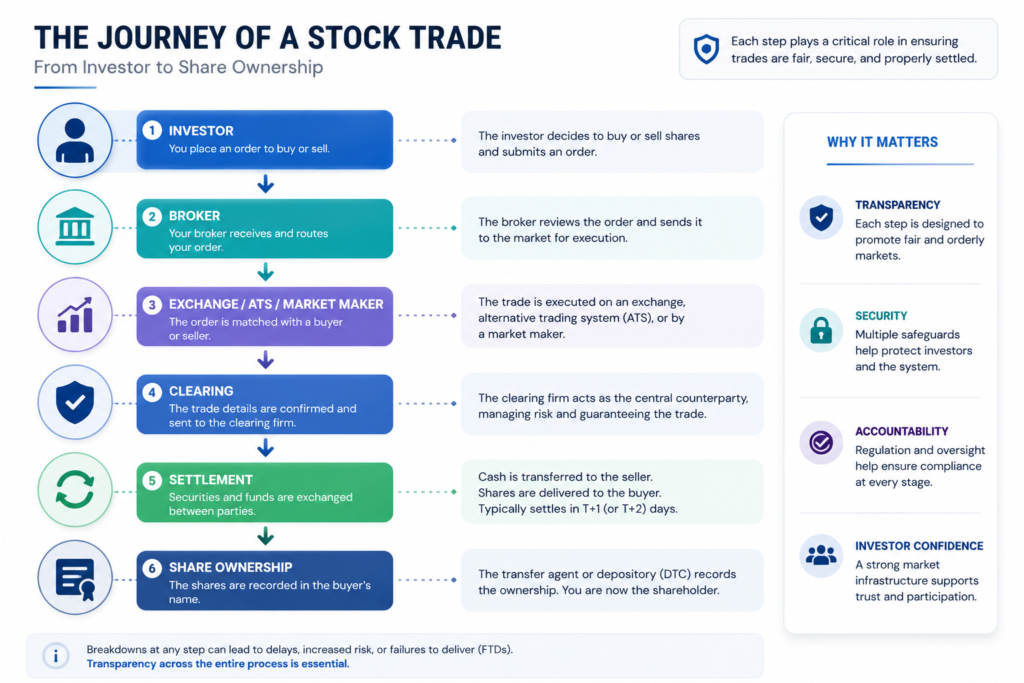
Every stock trade passes through several regulated participants before ownership is officially recorded. Understanding each stage provides important context for the topics that follow.
📚 Topics You’ll Learn
This section serves as NakedShortStop™’s educational reference library. Each topic explains a key part of modern market structure and will link to more detailed articles as they are published.
- How the Market Works
- Trade Execution and Settlement
- The Role of Brokers, Exchanges, and Clearing Houses
- Short Selling
- Naked Short Selling
- Failures to Deliver (FTDs)
- Regulation SHO
- Market Makers
- Dark Pools and Off-Exchange Trading
- Securities Lending
- Corporate Actions
- Why Market Structure Matters
How the Market Works
Every stock transaction begins with an investor placing a buy or sell order through a brokerage. While the process appears instantaneous, the trade actually passes through several regulated participants before ownership officially changes hands.
Depending on how the order is routed, it may be executed on a public stock exchange, through an alternative trading system (ATS), or internally by a market maker. Once executed, the trade is reported, matched, cleared, and ultimately settled through clearing organizations before becoming final.
Although most investors only see a completed trade confirmation, the transaction itself moves through multiple independent systems. Each participant has specific responsibilities governed by securities regulations designed to promote market integrity, transparency, and orderly markets.
Understanding this process provides the foundation for understanding many of the subjects discussed throughout NakedShortStop™, including settlement failures, securities lending, short selling, Regulation SHO, and market transparency.
Trade Execution and Settlement
When an investor submits an order, the trade is first executed. Execution simply means that a buyer and seller have agreed on a price.
Settlement is a separate process. During settlement, cash is delivered to the seller and ownership of the shares is transferred to the buyer. In U.S. equity markets, settlement generally occurs on the next business day (T+1), although the transaction has already appeared complete to the investor.
Between execution and settlement, multiple organizations help verify the transaction, match the trade details, manage risk, and ensure that both securities and cash are exchanged correctly.
The overwhelming majority of trades settle without issue. However, delays or failures can occur for a variety of legitimate operational reasons. Understanding this process provides important context for later topics such as Failures to Deliver (FTDs), securities lending, and Regulation SHO.
The Role of Brokers, Exchanges, and Clearing Houses
Modern stock trades involve several different organizations, each performing a specific function within the trading and settlement process.
A broker accepts an investor’s order and routes it for execution. Depending on the order and market conditions, it may be sent to a public stock exchange, an alternative trading system (ATS), or a market maker.
An exchange provides a regulated marketplace where buyers and sellers can trade securities. Alternative trading systems perform a similar function but generally operate outside the traditional exchange model.
After a trade is executed, clearing organizations help verify the transaction, manage counterparty risk, and oversee the transfer of cash and securities during settlement. These organizations play a critical role in maintaining confidence and stability in financial markets.
Although investors often experience the market as a single transaction, the process actually involves multiple regulated participants working together to complete each trade.
Short Selling
Short selling is a long-established and legal investment strategy in which an investor seeks to profit from a decline in a company’s share price.
Instead of purchasing shares first, a short seller typically borrows shares from another investor through a brokerage or securities lending arrangement and immediately sells them into the market. If the share price later declines, the short seller can purchase the shares at the lower price, return the borrowed shares, and retain the difference, less any borrowing costs and transaction fees.
Supporters argue that short selling can improve market liquidity and assist with price discovery by allowing negative information to be reflected in market prices. Critics argue that aggressive or abusive short-selling practices can contribute to excessive downward pressure on a company’s share price, particularly during periods of market stress.
Because short selling plays an important role in modern financial markets, it is subject to specific regulations designed to reduce settlement risk and promote orderly trading.
Naked Short Selling
Unlike traditional short selling, naked short selling occurs when a seller executes a short sale without first borrowing the shares or ensuring that the shares can be borrowed before settlement, where required under applicable regulations.
Naked short selling is not synonymous with ordinary short selling. While legitimate short selling generally involves borrowed securities, naked short selling raises questions about whether shares can be delivered at settlement.
In the United States, securities regulations, including Regulation SHO, were adopted in part to reduce settlement failures and address concerns related to certain forms of abusive naked short selling. Regulatory agencies have also recognized that some failures to deliver may occur for legitimate operational reasons and do not, by themselves, establish market manipulation.
Because the subject remains widely debated, NakedShortStop™ focuses on examining documentary evidence, regulatory actions, court records, settlement data, and publicly available disclosures rather than assuming conclusions based on any single data point.
Failures to Deliver (FTDs)
A Failure to Deliver (FTD) occurs when one party to a securities transaction does not deliver the shares to the buyer by the required settlement date.
An FTD is a settlement outcome—not a trading strategy. Failures to deliver can occur for a variety of reasons, including administrative errors, processing delays, corporate actions, securities lending complications, or other operational issues. Regulators have acknowledged that many FTDs are resolved quickly and do not necessarily indicate wrongdoing.
However, persistent or unusually large failures to deliver have attracted regulatory attention because they may, in certain circumstances, be associated with abusive trading practices or weaknesses in the settlement process. This concern contributed to the development of regulatory requirements such as Regulation SHO.
For this reason, NakedShortStop™ examines FTD data as one piece of evidence within a broader factual record. An FTD, by itself, does not prove market manipulation, but it can become relevant when considered alongside other documentary evidence, regulatory findings, court records, and market data.
Regulation SHO
Regulation SHO is a U.S. Securities and Exchange Commission (SEC) regulation adopted in 2005 to establish uniform requirements governing short selling and to reduce risks associated with failures to deliver.
Among its provisions, Regulation SHO requires broker-dealers to satisfy locate requirements before executing most short sales, helping ensure that securities can reasonably be expected to be available for delivery at settlement.
The regulation also established close-out requirements for certain failures to deliver and created additional reporting and compliance obligations intended to improve settlement discipline.
While Regulation SHO is a cornerstone of modern short-selling regulation, its effectiveness and enforcement remain subjects of ongoing discussion among regulators, market participants, academics, issuers, and investors.
NakedShortStop™ examines Regulation SHO through its published rules, SEC guidance, enforcement actions, academic research, and publicly available market data.
Market Makers
Market makers are firms that stand ready to buy and sell securities throughout the trading day. By continuously quoting bid and ask prices, they help provide liquidity, making it easier for investors to buy and sell shares without waiting for another investor to take the opposite side of the trade.
In carrying out this role, market makers operate under specific regulatory requirements and may, in limited circumstances, be permitted to rely on certain regulatory exemptions designed to support orderly markets and continuous trading.
While market makers play an essential role in modern financial markets, their activities have also been the subject of ongoing public discussion regarding transparency, order routing, and the use of regulatory exemptions. These issues continue to be examined by regulators, market participants, academics, and investors.
NakedShortStop™ evaluates market maker activity through publicly available regulatory guidance, enforcement actions, court filings, market data, and documented evidence.
Dark Pools and Off-Exchange Trading
Not all stock trades occur on public exchanges. A significant portion of trading activity takes place through alternative trading systems (ATSs), commonly referred to as dark pools, or through other forms of off-exchange trading.
Dark pools were originally developed to allow institutional investors to buy or sell large blocks of shares without immediately revealing their intentions to the broader market. By reducing the market impact of large orders, these venues can help institutional investors execute transactions more efficiently.
At the same time, the growth of off-exchange trading has prompted ongoing debate regarding market transparency, price discovery, competition among trading venues, and the visibility of order flow. Regulators continue to examine these issues through rule proposals, market studies, and public consultations.
NakedShortStop™ examines off-exchange trading using publicly available regulatory data, SEC and FINRA guidance, academic research, and documented market evidence. The objective is to understand how different trading venues influence overall market transparency and market structure.
Securities Lending
Securities lending is the process by which shares are temporarily loaned by one party to another, typically through a broker or institutional lending program. The borrower generally provides collateral and pays a fee for the use of the securities.
Securities lending plays an important role in modern financial markets by supporting activities such as short selling, market making, and liquidity management. Many institutional investors, including pension funds and mutual funds, participate in securities lending programs to generate additional income from long-term holdings.
Although securities lending is a widely accepted market practice, questions have been raised regarding transparency, beneficial ownership, share availability, and the relationship between securities lending and settlement. These issues continue to be examined by regulators, researchers, and market participants.
NakedShortStop™ reviews securities lending through publicly available regulatory guidance, market data, academic research, and documented evidence to better understand its role within the broader market structure.
Corporate Actions
Corporate actions are events initiated by a company that affect its securities or shareholders. These may include stock splits, reverse splits, special dividends, mergers, spin-offs, rights offerings, share buybacks, or changes to a company’s capital structure.
Although many corporate actions are routine, some can introduce additional complexity into the trading, clearing, and settlement process. Events involving special dividends, spin-offs, or the cancellation of trading may require market participants to reconcile ownership records, process new securities, or manage changes in settlement obligations.
For this reason, corporate actions often become significant reference points when examining market transparency, settlement, and shareholder records. They also frequently appear in NakedShortStop™ reports because they can provide valuable context for understanding how the market responds to major structural events.
NakedShortStop™ examines corporate actions using official company announcements, SEC filings, exchange notices, FINRA guidance, court records, and other primary source documents.
Why Market Structure Matters
Modern financial markets operate through a complex network of participants, regulations, and technology. For most investors, these systems remain largely invisible until an unusual event draws attention to how trades are executed, settled, and reported.
Understanding market structure provides the context needed to evaluate issues involving short selling, settlement, corporate actions, regulatory proposals, and market transparency. It also helps distinguish between routine market activity, legitimate operational challenges, and situations that warrant closer examination.
NakedShortStop™ believes informed discussion begins with informed understanding. By learning how the market is designed to function, readers are better equipped to evaluate evidence, interpret regulatory developments, and form their own conclusions based on documented facts rather than speculation.
This section is intended to serve as a living educational resource. As markets evolve and new issues emerge, additional topics, explanations, and reference materials will be added to help readers navigate an increasingly complex financial system.