Naked Short Selling Explained
How Short Selling, Settlement and Failures to Deliver Fit Together
What Is Naked Short Selling?
Understanding naked short selling begins with understanding how a normal stock trade is executed, settled, and recorded. This guide explains the mechanics of modern market structure before examining where settlement failures and transparency questions can arise.
Unlike conventional short selling, naked short selling occurs when a seller executes a short sale without first borrowing the shares or ensuring that the shares can be borrowed before settlement.
Legitimate short selling generally involves borrowing securities before they are sold short. Naked short selling raises different questions because it can result in transactions where shares fail to be delivered by the required settlement date under certain circumstances.
NakedShortStop™ examines this subject through publicly available regulatory guidance, court records, academic research, SEC filings, and documented market data. Our purpose is to explain how the process works, what current regulations require, and where questions of transparency continue to exist.
Whether you’re an investor, regulator, journalist, or simply trying to understand the debate, understanding how a normal stock transaction works is the first step toward understanding where settlement problems can occur.
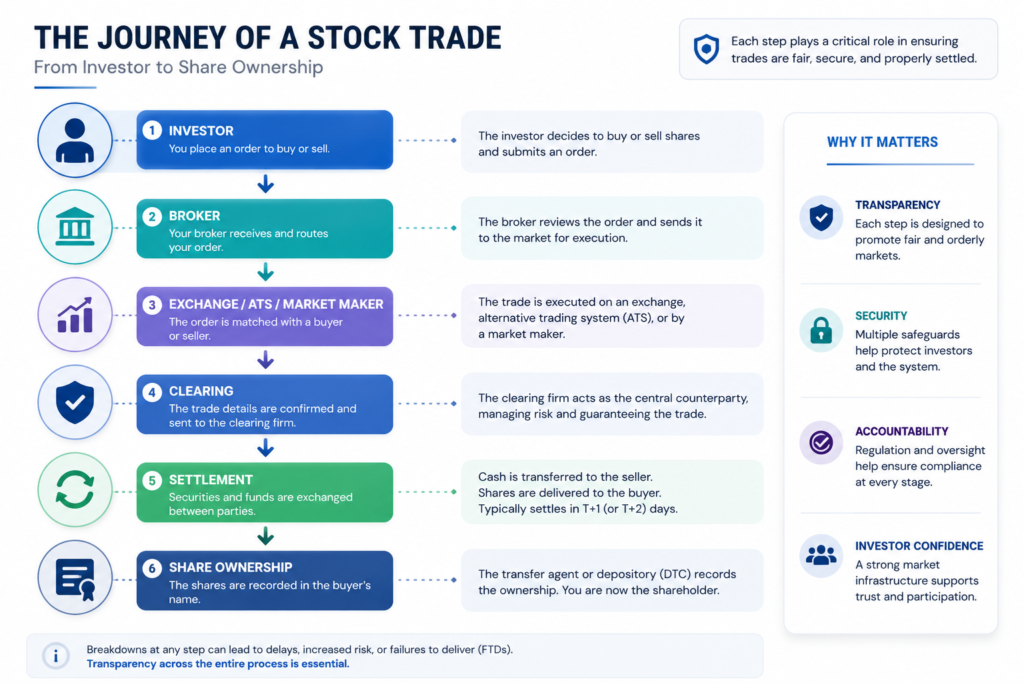
Figure 1. Simplified illustration of the typical stock trading and settlement process. Understanding the normal workflow provides the foundation for recognizing where settlement failures and naked short selling can become relevant.
How Does a Normal Short Sale Work?
Borrowing Before Selling
In a conventional short sale, an investor who believes a stock may decline in value first borrows shares from a broker or another lender before selling them into the market.
The investor later attempts to purchase the shares back at a lower price and return the borrowed shares to the lender. If the share price declines as expected, the difference between the selling price and the repurchase price represents the potential profit, before borrowing costs and other expenses.
Because the shares have been borrowed before the sale occurs, the buyer generally receives the securities through the normal settlement process.
What Is Securities Lending?
Securities lending is the process by which institutional investors, pension funds, mutual funds, ETFs, and other large shareholders temporarily lend shares to another market participant, typically through a broker.
The borrower pays a fee to borrow the shares and is contractually obligated to return equivalent shares at a later date. This lending market supplies much of the inventory used to facilitate conventional short selling.
Because shares are borrowed before they are sold, securities lending helps support orderly settlement and allows legitimate short selling to occur within existing market rules.
Where Do the Borrowed Shares Come From?
Contrary to a common misconception, brokers generally do not create shares to lend. Instead, they locate available shares from institutional investors or other clients who participate in securities lending programs.
The availability of borrowable shares can vary depending on market demand, investor ownership, and lending activity. When shares become difficult or expensive to borrow, borrowing costs often increase.
What Happens When Shares Cannot Be Borrowed?
In some situations, shares may be difficult or impossible to borrow before a short sale is executed. Regulations such as Regulation SHO require broker-dealers to satisfy specific locate requirements before executing most short sales.
Questions arise when trades are executed without a valid borrow or when settlement obligations are not completed as expected. These situations have become the focus of regulatory guidance, academic research, litigation, and ongoing public discussion.
What Is Naked Short Selling?
Naked short selling refers to a short sale in which the seller has not borrowed, or in certain circumstances has not ensured the shares can be borrowed, before executing the transaction.
Unlike conventional short selling, these transactions may create settlement obligations that are not completed by the required settlement date. This can result in a Failure to Deliver (FTD) under certain circumstances.
Because settlement outcomes can vary depending on the facts of each transaction, regulators, courts, researchers, and market participants continue to examine where these events occur, why they occur, and whether existing safeguards are sufficient.
Why Is Naked Short Selling Controversial?
Naked short selling has remained a subject of debate for more than two decades because different observers reach different conclusions about its frequency, causes, and market impact.
Some argue that existing regulations largely address the problem and that most settlement failures are resolved through normal market processes.
Others point to regulatory enforcement actions, academic research, litigation, market data, and documented settlement failures as evidence that additional transparency and stronger enforcement remain necessary.
NakedShortStop™ examines publicly available evidence rather than relying on assumptions, allowing readers to review primary sources and reach their own informed conclusions.
The debate extends beyond whether naked short selling occurs. It also concerns whether current public reporting provides investors with sufficient transparency to independently verify settlement obligations, beneficial ownership, and the effectiveness of existing safeguards.
Common Misconceptions
Some of the most common discussions surrounding naked short selling involve misunderstandings about how modern markets operate. The following clarifies several common misconceptions using publicly available information and current regulatory guidance.
🔵 Myth: All short selling is illegal.
🟢 Reality: Legitimate short selling is a legal and regulated market practice used in financial markets around the world.
🔵 Myth: Every Failure to Deliver proves naked short selling.
🟢 Reality: FTDs can occur for a variety of operational and market reasons.
🔵 Myth: Naked short selling and conventional short selling are the same thing.
🟢 Reality: They are distinct concepts with different regulatory considerations.
🔵 Myth: Every price decline is caused by short selling.
🟢 Reality: Stock prices are influenced by fundamentals, investor sentiment, liquidity, and many other factors.
🔵 Myth: Settlement data tells the entire story.
🟢 Reality: Publicly available settlement data provides valuable information but lacks transparency and does not reveal every aspect of the settlement process.
Key Takeaways
- Legitimate short selling and naked short selling are different practices. Conventional short selling relies on borrowed shares, while naked short selling raises questions about whether settlement obligations can always be fulfilled as intended.
- Failures to Deliver (FTDs) are an important transparency signal, not automatic proof of market manipulation. They can arise for multiple reasons, but persistent or unusually large settlement failures may warrant closer examination.
- Settlement transparency remains incomplete. While investors have access to significant regulatory filings, market data, and court records, important aspects of beneficial ownership and settlement obligations often cannot be independently verified through public information alone.
- Transparency matters because confidence matters. Investors, companies, regulators, and markets all benefit when settlement systems are transparent, verifiable, and trusted.
- When transparency is limited, legitimate questions deserve legitimate answers. Public confidence is strengthened by evidence, accountability, and the ability to independently verify how markets operate.
Why Transparency Matters
Financial markets depend on confidence, and confidence depends on transparency. Investors, companies, regulators, and the public all benefit when settlement obligations can be independently verified and important questions can be examined using publicly available evidence.
NakedShortStop™ exists to organize evidence—not to ask readers to accept predetermined conclusions. By understanding how the system is intended to operate, readers are better equipped to evaluate new developments, regulatory proposals, enforcement actions, and individual case studies on their own.